
GEOFLEXHeat shines at SEEP 2025 Geothermal Energy Symposium
From 28–31 July 2025, Brunel University of London hosted the 17th International Conference on Sustainable Energy and Environmental Protection (SEEP), a key platform for experts and innovators in sustainable energy systems. This year’s programme featured a dedicated Geothermal Energy Symposium, chaired by Per Kjellgren, CEO at Flowphys, which provided an in-depth exploration of geothermal energy’s potential to deliver large-scale, zero-emission industrial heating and cooling solutions. The symposium was made possible thanks to the organisation of Brunel University of London and the leadership of GEOFLEXHeat Project Copordinator, Prof. Hussam Jouhara, whose coordination brought together leading voices from academia, research institutions, and industry.
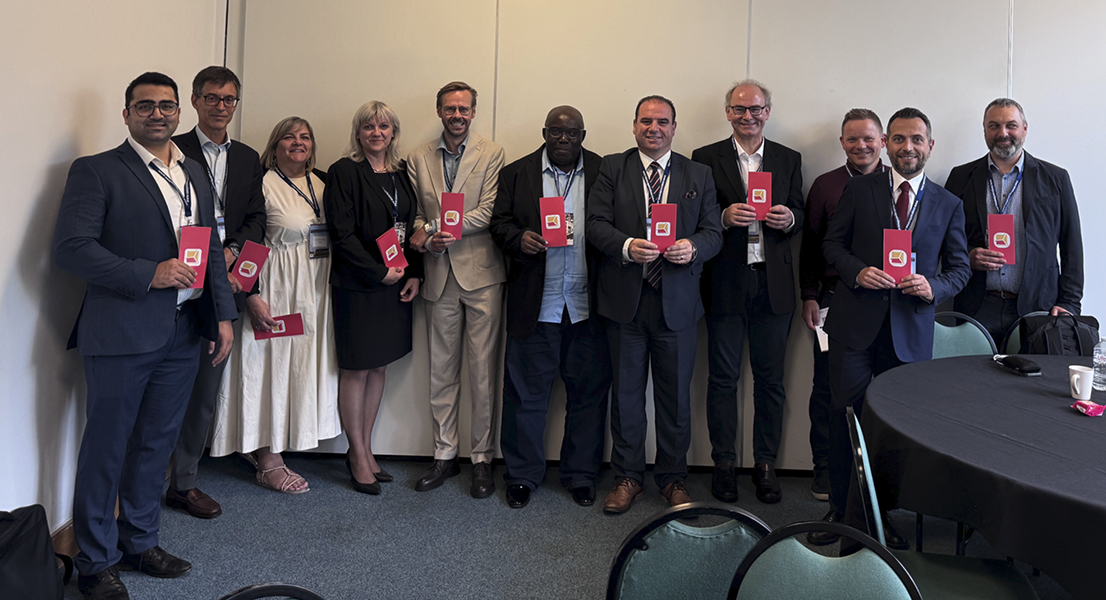
GEOFLEXHeat, the Horizon Europe project redefining geothermal energy deployment kicked off in October 2024, played a prominent role in the symposium. Presentations from consortium partners reflected the project’s integrated approach, combining advanced engineering, data analytics, and market strategies to unlock geothermal’s role in Europe’s decarbonisation roadmap.
Loredana Torsello, Manager for International and Complex Projects at COSVIG, addressed the importance of public perception and involvement with “Increasing the Social Engagement in Geothermal Projects: the Case of Italy”, a deep dive into strategies that improve community participation and accelerate geothermal project development. In parallel, Hermann Baldursson, Director of Finance at Baseload Power Iceland, offered valuable perspectives on market creation in “Unlocking Local Geothermal Markets in Iceland and Beyond”, sharing Iceland’s pioneering success in building robust, decentralised geothermal ecosystems.
Policy frameworks were a strong focus, with Prof. Jurgita Malinauskaite, Head of Brunel Law School at Brunel University of London and Senior Researcher at Vytautas Magnus University, Lithuania, presenting “Policies to Boost Geothermal Energy Potential in Europe”. Her analysis of regulatory challenges and enabling frameworks added a crucial dimension, connecting technical progress to the legislative and market conditions needed to accelerate geothermal deployment. Joel Boehme, Campaign Manager for the Clean Heat Europe Campaign at the European Heat Pump Association, also explored these intersections in “Clean Heat Solutions: A Market and Policy Outlook”, identifying key strategies to integrate geothermal heating into Europe’s energy transition plans, and highlighted how European policymakers have promised concrete support for geothermal, such as a dedicated Geothermal Action Plan.
Technical innovation took centre stage with Matteo Quaia, General Manager at Rete Geotermica, presenting “Zero Emissions Geothermal Power Plants: State of the Art”, a comprehensive analysis of technologies enabling emissions-free baseload energy. Building on operational optimisation, Paolo Taddei Pardelli, Managing Director at Spike Renewables, introduced the GEOFLEXHeat project’s pioneering “Scaling Reduction System”, a targeted solution developed to address mineral precipitation challenges (notably silica and stibnite) in geothermal heat recovery systems.
This innovation builds on prior experience from the GeoSmart project, where kinetic modelling of silica polymerization and scaling mechanisms laid the groundwork for optimized reactor and retention systems.
The GEOFLEXHeat solution features
- Dual chemical treatment: upstream stibnite inhibitor injection at 200°C, and downstream lime dosing to precipitate silica at lower temperatures.
- A cyclone-shaped reactor and retention system that accelerate silica removal through pH control and Ca/Si ratio adjustment, achieving significant scaling reduction within 30 minutes.
- Heat exchanger recovery: ~3 MW thermal extraction between 104°C and 50°C, repurposed for district heating.
- System design for real-world implementation at Amiata Energia (Bagnore, Italy) using high-temperature brine (up to 200°C, 25 bar), showcasing compatibility with industrial geothermal loops.
The system offers clear benefits:
- Extended lifetime of reinjection wells by reducing fouling.
- Improved energy efficiency via deeper heat recovery.
- Scalable design suitable for other high-enthalpy geothermal sites.
- Potential material reuse via mineral recovery from precipitated silica.
The presentation concluded with ongoing testing and optimisation plans, including a 6-month on-site validation campaign and further assessments of economic and environmental impacts.
The symposium also highlighted data-driven engineering tools and real-world performance insights. Per Kjellgren of Flowphys presented “Flow Assurance + Key Results from Multiple Geothermal Projects”, offering lessons learned from diverse geothermal settings to reduce operational costs and improve system stability. Flowphys also showcased the development of “An Online Open Access Geothermal Simulator with AI Support & Optimization”, a dynamic simulation platform combining artificial intelligence and predictive modelling for smarter system design. Complementing these tools, Pufinji Obene, CEO at Oliveris, explored AI-driven exploration with “Real-Time Drilling Intelligence: A New Approach to Lithology Prediction for Geothermal and Beyond”, demonstrating how machine learning enhances drilling accuracy and reduces exploration risks.
The GEOFLEXheat consortium’s contributions at SEEP 2025 underscored the project’s multi-dimensional approach: integrating advanced hardware and digital innovation with policy engagement, market development, and public acceptance. The symposium’s discussions reaffirmed that geothermal energy, when paired with innovations in AI, flow assurance, and emissions-free systems, is not only technically viable but strategically positioned to drive Europe’s energy transition.
The SEEP Conference is an annual event, serving as a forum for international experts to exchange insights and accelerate the deployment of clean energy technologies. Following the success of the 2025 edition, the geothermal community is already looking ahead to the 2026 Conference, which promises to showcase even more advanced solutions and real-world demonstrations from GEOFLEXheat and its partners.